

Flip book element
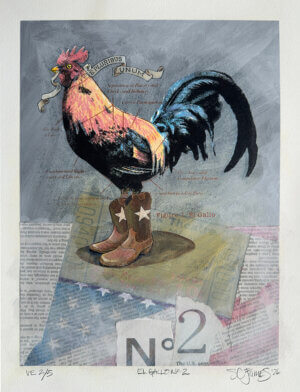
El Gallo No. 2 Variable Edition 2/5
El Gallo No. 2 Variable Edition 2/5
S.C. James, June 2026
El Gallo symbolizes courage, vigilance, masculinity, and the dawn of a new day. Here, he’s satire aimed at our present political system — leaders too afraid to do right by the country, but quick to boast about how hard they’re working for the American people. Think Foghorn Leghorn: all crow, no follow-through. I swapped the Bald Eagle and its E Pluribus Unum banner for the rooster because he felt right for the moment — a bird that can crow endlessly about nothing, hoping the noise drowns out the ineptitude underneath.
The barely legible copper text names the pillars of our democracy, diluted and devalued to the point they feel as obsolete as the penny we’ve just discarded:
- Separation of Powers and Checks and Balances
- The Rule of Law
- Citizen Participation
- Fundamental Rights and Civil Liberties
- The U.S. Constitution and Limited Government
- Free, Fair, and Competitive Elections
- A Free and Independent Press
Image size: 9 x 12 in, on 100% cotton rag heavyweight paper
8-color screen print, gesso, acrylic, oil-based colored pencil, and watercolor
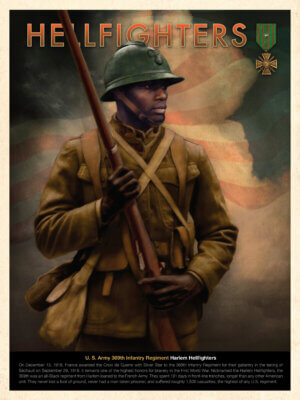
Original Harlem Hellfighters Séchault vintage-style poster
Price range: $24.50 through $36.50
Original Harlem Hellfighters Séchault Vintage-style poster by S.C. James. Months earlier, the 369th had been “loaned” to the French Fourth Army and folded into the 161st Division. In the offensive’s first three days, the 161st pushed north through the Champagne countryside against stiff German resistance.
On the morning of September 29, 1918, the 369th was ordered to take Séchault. They jumped off at about 2:45 PM from the high ground south of the village.
What made the attack remarkable — and brutal — was that they went in without artillery support. To reach Séchault, they had to cross open ground, a plain swept by German machine-gun fire and pounded by Austrian 88mm guns. Casualties were severe. But they kept moving, fought through the streets, and took the town by late afternoon.
The offensive as a whole cost the 369th roughly a third of its strength. They were pulled out of the line in early October, having fought their last major action of the war. The Séchault assault is what the unit citation specifically commemorates — it was for that fight, on that afternoon, that the French Army pinned the Croix de Guerre with Silver Star to the regimental colors on December 13, 1918, at a ceremony in occupied Germany.
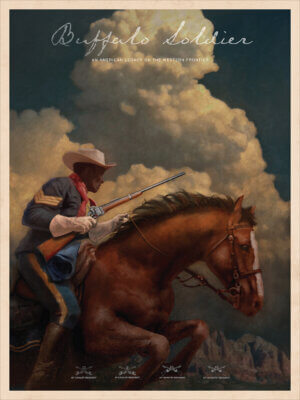
Buffalo Soldier: Legacy on the frontier Poster
Price range: $24.50 through $36.50
Buffalo Soldier: Legacy on the frontier poster by S. Christopher James. This vintage style poster honors the legacy of the Buffalo Soldiers—African American troops who served on the Western frontier after the Civil War. Drawn from the 9th and 10th Cavalry Regiments, these men faced discrimination within their own country, even as they were tasked with enforcing its expansion.
Nicknamed “Buffalo Soldiers” by Native American tribes, the name is believed to reflect both their strength and determination, as well as the resemblance of their hair to the thick fur of the buffalo. Some say it was a title of deep respect, earned through fierce combat and unwavering discipline.
Yet their story is layered. While they fought bravely for a nation that often denied them basic rights, they were also agents in the displacement of Indigenous peoples—another community fighting for survival.
This work stands in the space between pride and paradox, reflecting on what it meant to serve, to survive, and to seek dignity in a complicated chapter of American history.

Harlem Hellfighters Poster
Price range: $19.50 through $36.50
This Harlem Hellfighters Poster is a tribute to the 369th Infantry Regiment of the United States Army — an African American unit that served with extraordinary distinction during World War I. Many of its soldiers came from Harlem, New York, and from communities across the nation, answering a call to serve a country that still denied them equality.
Because of racial segregation within the U.S. Army, the regiment was assigned to fight under French command. Issued French helmets and weapons, they entered the trenches not as replacements, but as frontline soldiers. They would go on to spend 191 days in continuous combat — more than any other American unit in the war.
The Harlem Hellfighters fought in major campaigns along the Western Front and earned a reputation among the French for fierce determination and unbreakable resolve. Their courage was so profound that many members of the regiment were awarded the French Croix de Guerre for heroism.
Though they returned home to a segregated nation, their legacy could not be contained. The Harlem Hellfighters became a symbol of African American patriotism, excellence, and sacrifice — and a powerful force in the long struggle for civil rights in the United States.
This poster is an original illustration by S.C. James of Union Design Company, created in a retro style inspired by early 20th-century war-era propaganda art. It honors a unit that fought two wars at once — one overseas, and one at home.
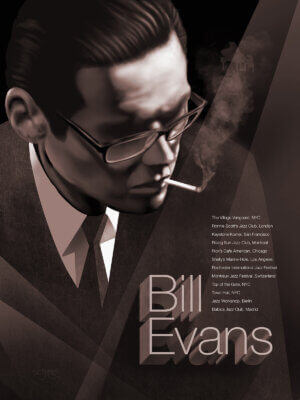
Bill Evans Vintage Poster
Price range: $24.50 through $36.50
Bill Evans vintage Poster by S.Christopher James. Bill Evans (1929–1980) was one of the most influential jazz pianists in history, known for his deeply lyrical touch, rich harmonic language, and introspective style. Emerging in the late 1950s, he helped redefine jazz piano by blending classical impressionism with modern jazz harmony, creating a sound that was both delicate and emotionally complex. Evans rose to wider prominence as a member of Miles Davis’s Kind of Blue sextet, contributing significantly to the album’s modal approach, before leading his own groundbreaking trios that emphasized subtle interaction and equality among musicians. His playing was marked by shimmering voicings, sensitive phrasing, and a quiet intensity that continues to shape jazz pianists across generations.
Some of Bill Evans’s most notable and widely recognized compositions, many of which have become jazz standards:
Waltz for Debby – His most famous piece; tender, lyrical, and one of the defining jazz waltzes.
Peace Piece – A meditative, minimalist piano work that reveals his classical and impressionist influence.
Blue in Green – Co-credited with Miles Davis; haunting, modal, and one of the most recorded ballads in jazz.
Very Early – A beautifully crafted early composition showing his harmonic sophistication.
Turn Out the Stars – Lush, emotional, and frequently performed by later pianists.
Time Remembered – Dreamlike and harmonically advanced, often cited as one of his most personal works.
Peri’s Scope – More angular and modern, showing his rhythmic and compositional range.
We Will Meet Again – Written late in his life, deeply reflective and poignant.
Bill Evans didn’t just play the piano — he revealed it.
His music lived in the quiet spaces: between notes, inside unresolved chords, in the fragile beauty of restraint. Where others dazzled, Evans whispered. And in that whisper, he changed jazz forever. A central voice on Kind of Blue and the architect of the modern piano trio, Evans blended classical impressionism with jazz improvisation, creating a sound that felt more like memory than performance.
This print honors an artist who proved that subtlety can be revolutionary — and that the softest voices often echo the longest.

Buffalo Soldier Spanish-American War Poster
Price range: $24.50 through $36.50
The Buffalo Soldier Spanish-American War Poster commemorates their contribution during the War with Spain in 1898. All four Buffalo Soldier regiments played a crucial role . By this time, the Buffalo Soldiers—once seen as intruders on the western frontier by Native American and frontier settlements alike—had earned their reputation as heroes, becoming an indispensable part of the U.S. Army. When the Army mustered all available forces to assault Cuba, the Buffalo Soldiers were among those called to action.
On June 22, 1898, the 9th and 10th Cavalry regiments landed in Cuba and soon found themselves fighting alongside Col. Theodore Roosevelt’s Rough Riders. This unexpected pseudo-integration proved pivotal just two days later at the Battle of Las Guasimas. During the engagement, the Rough Riders charged headlong into a deadly “kill zone” where entrenched Spanish riflemen pinned down their unit. The 10th Cavalry, demonstrating tactical brilliance and bravery, flanked the Spanish positions, forcing their retreat and rescuing the Rough Riders from disaster. This act of heroism made headlines across the United States and underscored the Buffalo Soldiers’ critical role in the campaign.
The Buffalo Soldiers’ contributions did not end there. While the Rough Riders received much of the glory for the July 1, 1898, assault on San Juan and Kettle Hills, the attack’s success was largely due to the Buffalo Soldiers. The Spanish infantry, well-entrenched on the San Juan Heights, held a commanding position over Santiago. The geography and lack of effective American artillery necessitated a bold frontal assault.
Recognizing the perilous nature of the mission, the 10th Cavalry and the 24th Infantry, both Buffalo Soldier units, volunteered to lead the final charge. Racing across open terrain under relentless enemy fire, their speed and determination minimized casualties and inspired their fellow soldiers. As the 10th Cavalry pressed the attack on San Juan Hill, the Rough Riders followed their lead, assaulting the smaller Kettle Hill in support.
This collective effort broke the Spanish defenses, leading to a decisive American victory and ultimately securing Santiago. The bravery and sacrifice of the Buffalo Soldiers during these battles were instrumental, even though their contributions were often overshadowed by the fame of the Rough Riders.
“White regiments, black regiments, regulars, and Rough Riders, representing the young manhood of the North and the South, fought shoulder to shoulder, unmindful of race or color, unmindful of whether commanded by an ex-Confederate or not, and mindful only of their common duty as Americans.”
— 1st Lt. (later General of the Armies) John “Black Jack” Pershing commenting in November 1898 on the unity he witnessed during the campaign in Cuba while leading part of the 10th Cavalry.
More reading of the war here:
https://www.thenmusa.org/articles/buffalo-soldiers/
https://www.nps.gov/articles/000/busospanamwar.htm
https://www.history.com/news/buffalo-soldiers-spanish-american-war-san-juan-hill-rough-riders
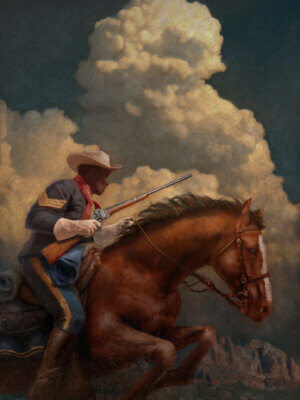
Buffalo Soldier: Legacy on the Frontier art print
Price range: $19.50 through $36.50
Buffalo Soldier: Legacy on the frontier by S. Christopher James, honors the legacy of the Buffalo Soldiers—African American troops who served on the Western frontier after the Civil War. Drawn from the 9th and 10th Cavalry Regiments, these men faced discrimination within their own country, even as they were tasked with enforcing its expansion.
Nicknamed “Buffalo Soldiers” by Native American tribes, the name is believed to reflect both their strength and determination, as well as the resemblance of their hair to the thick fur of the buffalo. Some say it was a title of deep respect, earned through fierce combat and unwavering discipline.
Yet their story is layered. While they fought bravely for a nation that often denied them basic rights, they were also agents in the displacement of Indigenous peoples—another community fighting for survival.
This work stands in the space between pride and paradox, reflecting on what it meant to serve, to survive, and to seek dignity in a complicated chapter of American history.

Strange Meadowlark Poster
Price range: $24.50 through $36.50
Strange Meadowlark Poster by S. Christopher James is an art composition that plays off the jazz tune of the same name, composed by Dave Brubeck and featured on his groundbreaking 1959 album “Time Out.” In this composition, the drinking bird, painted in the colors of a meadowlark, sees Brubeck as equally strange, as he was not typical of many jazz musicians at the time. While some of the most talented jazz musicians of the 1950s and 1960s turned to drugs and alcohol to cope with various issues, Brubeck was known for his discipline and focus on innovation.
Strange Meadowlark begins with a lyrical and classically influenced piano solo by Brubeck before transitioning into a swing rhythm as the rest of the quartet joins in. Paul Desmond’s saxophone then takes the lead, carrying the main melody. The tune is known for its blend of classical and jazz elements, which is a hallmark of Brubeck’s distinctive style.
Dave Brubeck (1920–2012) was an American jazz pianist and composer, renowned for his innovative approach to jazz and his contributions to the genre’s popularity in the 1950s and 1960s. He is best known for his work with the Dave Brubeck Quartet, which featured Paul Desmond. Together, they released the groundbreaking album “Time Out” in 1959, which included the hit song “Take Five,” composed by Desmond. “Take Five” became famous for its distinctive 5/4 time signature, which was unusual in jazz at the time and helped push the boundaries of rhythm in the genre.
Brubeck’s music often explored complex rhythms and time signatures, incorporating elements of classical music, making him a pioneer in cool jazz and West Coast jazz. Besides “Strange Meadowlark,” other notable works on the “Time Out” album include “Blue Rondo à la Turk” and “Unsquare Dance.”
Beyond his music, Brubeck was known for his commitment to civil rights. He refused to perform in segregated venues and often led integrated bands, which made a powerful statement against racial discrimination during the civil rights era.
Create a Flip Book for any product category. You can also select custom posts.