

Art Traveler
The Quiet Mission of Lt. Jeff Long: How a blue-suited toy astronaut beat NASA to the Moon — and why Mattel put him there in 1968

Apr
In the mid-1960s, as the United States and the Soviet Union raced for the heavens, American toy companies looked up too. Hasbro’s G.I. Joe had proved in 1964 that boys would play with a 12-inch articulated figure if you didn’t call it a doll. Mattel, the Hawthorne, California, outfit behind Barbie, decided to answer back — not on the battlefield, but on the Moon.
In 1966 Mattel launched Major Matt Mason, “Mattel’s Man in Space,” a six-inch astronaut whose rubbery Plastizol body was molded over a bendable wire armature and topped with a removable helmet modeled on early NASA gear. The designs were cribbed from the pages of Life, Air Force Magazine, and Jane’s. The smaller scale was deliberate: it let Mattel build out an entire lunar ecosystem of space sleds, jet propulsion packs, rocket launchers, and crawlers around him. The line was an immediate hit, following “the triumphant arc of NASA’s Apollo program” onto lunch boxes, coloring books, and Halloween costumes.
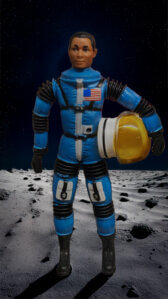
Major Mason, in a white suit, was the commander. Sgt. Storm, in red, and Doug Davis, in yellow, rounded out the original crew. Then, in 1968, Mattel added a fourth figure: Lt. Jeff Long, a Black astronaut in a blue suit, billed as the team’s science officer and second-in-command. The quiet thing about Jeff Long is that he arrived at a moment when NASA’s own astronaut corps was still entirely white.
Why now? The answer is woven out of three threads — a country on fire, a consumer class no longer invisible to advertisers, and a toy company headquartered a short drive from Watts.
A country on fire, a toy aisle under pressure
To understand Jeff Long, you have to understand what 1968 felt like on the ground. In March, the Kerner Commission delivered its 426-page verdict on the urban uprisings of the previous summers, warning that the United States was “moving toward two societies, one black, one white — separate and unequal,” and explicitly faulting newspapers and television for failing to report on Black American life or to employ more than “a token number of blacks.” In April, the Reverend Dr. Martin Luther King Jr. was assassinated in Memphis and President Lyndon Johnson signed the Fair Housing Act.
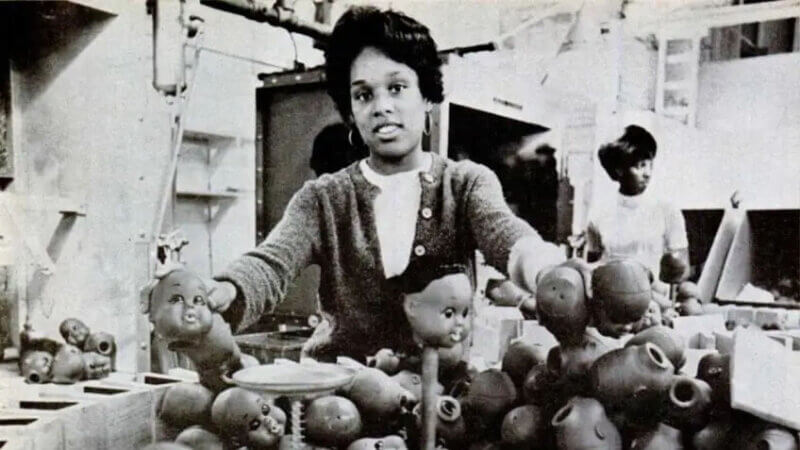
Black Americans were demanding not just civil rights but visibility — in classrooms, in newsrooms, and on store shelves. Activists had begun turning their attention to toys, which they argued shaped how children of every race saw themselves and each other. In South Los Angeles, just miles from Mattel’s headquarters, two Black community organizers, Lou Smith and Robert Hall, were building on that idea. In early 1968 they sat down with Mattel president Elliot Handler to ask the world’s largest toy company for help. The result was Shindana Toys, a division of their community organization Operation Bootstrap, which had been founded in the aftermath of the 1965 Watts uprising. Mattel provided factory training, supplies, industry contacts, and capital “with a no-strings attached stipulation,” per Smith and Hall’s request.6 Later that year Shindana released Baby Nancy, the first American doll to feature natural hair and Afrocentric features.
The same year, Mattel quietly introduced Christie, Barbie’s first Black friend — the first Barbie-line doll sculpted with a face mold designed to reflect African American features. Christie arrived in the same months as the black-gloved salute of Tommie Smith and John Carlos at the Mexico City Olympics, and the year before Diahann Carroll’s “Julia” became the first prime-time network show to star a Black woman in a non-stereotyped role.
Seen alongside Christie and the Shindana partnership, Lt. Jeff Long starts to look less like a one-off gesture and more like part of a coordinated reading of the moment.
A business decision, too
That reading had a ledger behind it. African American purchasing power had climbed from roughly $3 billion in 1940 to an estimated $32 billion by 1970, and by the late 1960s ad agencies were actively segmenting and courting Black consumers as a distinct market rather than assuming their tastes mapped onto white households. Glossy magazines like Ebony and Jet gave marketers a direct channel to Black middle-class families; by 1970 the census showed 81 percent of Black Americans living in urban areas, a concentrated and reachable audience.
Toy companies had begun testing that market. Hasbro had added a Black “Action Soldier” to its G.I. Joe line in 1965 — though the figure was a Caucasian head mold cast in brown vinyl rather than a purpose-designed sculpt, and it remained on shelves through 1968. That was the bar Mattel cleared, and then some: Jeff Long was given his own name, rank, and specialty — science officer — not just a reskinned body. Mattel’s television advertising reinforced the message. Period spots for the Matt Mason line are remembered for showing Black and white children playing together with the toys, a then-novel choice on American TV.
Mattel never issued a formal statement explaining the decision to add Jeff Long, and the record does not show whether the impetus came from a specific designer, marketer, or executive. But the pattern across 1968 — Christie, Jeff Long, the Shindana partnership, integrated advertising — suggests a company that had concluded, correctly, that doing the right thing and reaching a growing audience were not mutually exclusive.
Beating NASA to the Moon
The irony of a Black science officer in a 1968 toy aisle is sharpened by what was happening at Cape Kennedy. In 1961, at President Kennedy’s direction, Air Force Captain Ed Dwight had become the first African American to enter the test-pilot pipeline that fed NASA’s astronaut corps. His candidacy became cover material for Ebony, Jet, and Sepia. By his own account, white instructors and classmates at Edwards Air Force Base were “livid” at the attention; he placed eighth as a contender for NASA’s Astronaut Group 3 in October 1963, and only the first seven were selected. Dwight resigned from the Air Force three years later, went on to become a celebrated sculptor, and did not fly to space until a 2024 Blue Origin flight at age 90.
Guion Bluford became the first African American to reach orbit in 1983 — fifteen years after Mattel put a blue plastic version of him on toy shelves. Between the end of Apollo and the start of the Space Shuttle program there was a long, unglamorous gap in American crewed spaceflight. Imagination, as the Major Matt Mason line demonstrated, did not pause.
Artemis catches up to the toy aisle
Fifty-eight years after Mattel shipped a blue-suited Black science officer to children’s bedrooms, NASA finally sent the real thing toward the Moon.
On April 1, 2026, an SLS rocket lifted off from Kennedy Space Center’s Pad 39B carrying the four- person crew of Artemis II: Commander Reid Wiseman, pilot Victor Glover, mission specialist Christina Koch, and Canadian Space Agency mission specialist Jeremy Hansen. It was the first crewed mission to the Moon since Apollo 17 in 1972, and the farthest any human had traveled from Earth in more than half a century — a peak distance of 252,756 miles. The crew splashed down off the coast of San Diego on April 11, 2026, ten days after launch.
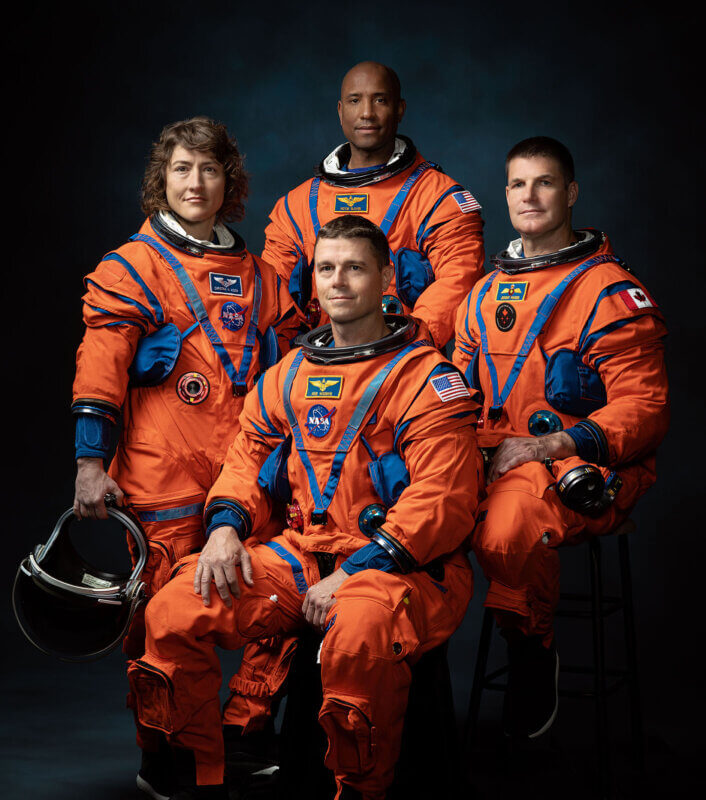
A 10-day lunar flyby, April 1–11, 2026 — the first crew to circle the Moon since 1972.
Cmdr. Reid Wiseman (NASA) — Commander. U.S. Navy test pilot; former NASA chief astronaut. At 50, the oldest person to travel beyond low Earth orbit.
Victor Glover (NASA) — Pilot. Veteran of four spacewalks. First person of color to travel beyond low Earth orbit and around the Moon.
Christina Koch (NASA) — Mission Specialist. Holds the record for the longest single spaceflight by a woman (328 days). First woman to travel beyond low Earth orbit and around the Moon.
Jeremy Hansen (CSA) — Mission Specialist. Royal Canadian Air Force colonel; first spaceflight. First non-U.S. citizen to travel beyond low Earth orbit and around the Moon.
Photo by Josh Valcarcel
Artemis II was, among other things, a set of firsts that would have read like science fiction in 1968. Glover became the first person of color to travel beyond low Earth orbit and around the Moon. Koch became the first woman to do so. Hansen became the first non-U.S. citizen. The lone white male American on board, Wiseman, earned a first of his own: at 50, he was the oldest person to make the trip.
It is hard not to notice the resemblance. Jeff Long was Major Mason’s second-in-command in a blue suit; Glover was Wiseman’s second-in-command in a blue NASA flight suit. Mattel’s 1968 crew was four astronauts of mixed backgrounds circling a plastic Moon base; NASA’s 2026 crew was four astronauts of mixed backgrounds circling the real one. The toy’s imagined future arrived, several decades late, largely intact.
Why a blue-suited toy still matters
The Matt Mason line itself did not last long. By 1970 public interest in the Apollo program had cooled, the wire-framed figures were notorious for snapping at the elbow, knee, and hip, and Mattel quietly retired the toys. Jeff Long was on shelves for only about two years.
But his shelf life is not the same as his half-life. For many children — especially Black children — he was proof of concept: the future, whatever it looked like, could include them. He arrived in a toy aisle that had, a generation earlier, offered Black children mostly absence or caricature, and he arrived as a specialist, a leader, and a hero rather than a sidekick.
Today the conversation about diversity, equity, and inclusion has once again moved to the center of American politics, and once again it is contested. Federal and state programs are being rolled back; corporate initiatives are being renamed or retired; the word “representation” is treated, in some quarters, as an accusation. The story of Lt. Jeff Long is a useful artifact for that argument — not because it settles anything, but because it shows how unremarkable, and how generative, the simplest version of inclusion could be. A Los Angeles toy company, under no federal mandate, looked at the country it was selling into, looked at who was buying its toys and who wasn’t, looked at the activists walking into its CEO’s office, and made a six-inch blue-suited astronaut who told every kid holding him that space was for them too.
The children who held that toy in 1968 are grandparents now. Some of them watched Artemis II lift off this month on the same televisions their grandchildren use to stream it. Fifty-eight years after a toy company imagined a more inclusive crew than the country could muster, the country finally sent one around the Moon. The action figure is a collector’s item. The promise he represented just flew 252,756 miles and came home.
Notes
- G.I. Joe, first produced by Hasbro in 1964, is widely credited with inventing the “action figure” category as a term and a concept marketed to boys. See “G.I. Joe,” Britannica; “The Action-Packed History of G.I. Joe,” Google Arts & Culture.
- “Major Matt Mason,” Wikipedia (accessed April 2026), including the production dates, crew composition, Plastizol/wire-frame construction, 1968 addition of Lt. Jeff Long as a Black second-in-command, an contemporaneous integrated advertising.
- Kelly Heyboer, “Major Matt Mason: Mattel’s Man in Space, 1966–1970,” We Are the Mutants, July 13, 2017; see also “Meet Matt Mason, the Mattel toy that brought space to life for boomer kids,” Fast Company, May 9, 2019.
- National Advisory Commission on Civil Disorders (Kerner Commission), Report, 1968; excerpts and analysis at History Matters (George Mason University) and Smithsonian Magazine, “The 1968 Kerner Commission Got It Right, But Nobody Listened,” March 2018.
- “Civil Rights Act of 1968 (Fair Housing Act),” U.S. Department of Housing and Urban Development; “Assassination of Martin Luther King Jr.,” History.com.
- “Shindana Toys,” Wikipedia; “Black Power in the Dollhouse: Shindana Toys and the Business of Social Change,” Business History Conference; “A History of Shindana Toys,” The Strong National Museum of Play, via Google Arts & Culture. All three sources document the early-1968 meeting between Lou Smith, Robert Hall, and Mattel president Elliot Handler, and Mattel’s “no-strings” support.
- “Christie,” Barbie Wiki; “How the First Black Barbie Was Born,” Smithsonian Magazine; “Christie: Barbie’s First Black Friend and Her Lasting Impact on Doll Diversity,” Black Dolls Matter. Notes the 1968 release, the new face sculpt, and the cultural context (Olympic salute; Julia, 1968–1971).
- Duke University Libraries, “Marketing to Minorities: Expansion and Development (1950s–1990s),” online exhibit; see also the R.J. Reynolds industry document cited there estimating Black purchasing power at $32 billion in 1970.
- “The Black History of G.I. Joe,” The CSPN; “Action Soldier (Negro),” vintage3djoes.com; Rob Goldberg, Radical Play: Revolutionizing Children’s Toys in 1960s and 1970s America (Duke University Press, 2023).
- “Ed Dwight,” Wikipedia; “Ed Dwight was in line to be the first Black astronaut. History had other ideas,” NPR, July 5, 2022; “Ed Dwight Was Going to Be the First African American in Space. Until He Wasn’t,” Smithsonian Magazine.
- “Guion Bluford,” NASA biography; Bluford flew on STS-8 in August 1983.
- “NASA’s Artemis II Launch Mission Countdown Begins,” NASA, March 30, 2026; “Our Artemis Crew,” NASA; “Meet NASA’s Artemis II crew, who will usher in a new era of deep-space exploration,” CNN, March 27, 2026.
- “NASA Welcomes Record-Setting Artemis II Moonfarers Back to Earth,” NASA news release; “Artemis II Splashdown and Return,” NASA, April 11, 2026; “Artemis II Astronauts Back in Houston, Reunite with Families,” NASA, April 11, 2026.
- “Artemis II,” Wikipedia (accessed April 2026); “International News: Artemis II crew includes First Woman, Black Astronaut and Canadian ever flown to moon,” BreakingBelizeNews, April 11, 2026; World Economic Forum, “NASA names first woman, Black astronauts to Artemis II crew,” April 2023 (confirming the historic firsts that were realized in the April 2026 flight).
- For current DEI policy context and rollbacks, see recent coverage in the New York Times, Washington Post, and Harvard Business Review (2024–2026). Specific policies vary by state and institution; readers are encouraged to consult primary sources.
