

Art Traveler
NFTs, Five Years Later: Revisiting Art on the Blockchain
Apr
An update to my original 2021 post on Ethereum, NFTs, and the crypto art market.
When I wrote about NFTs back in 2021, a JPEG had just sold at Christie’s for $69 million.
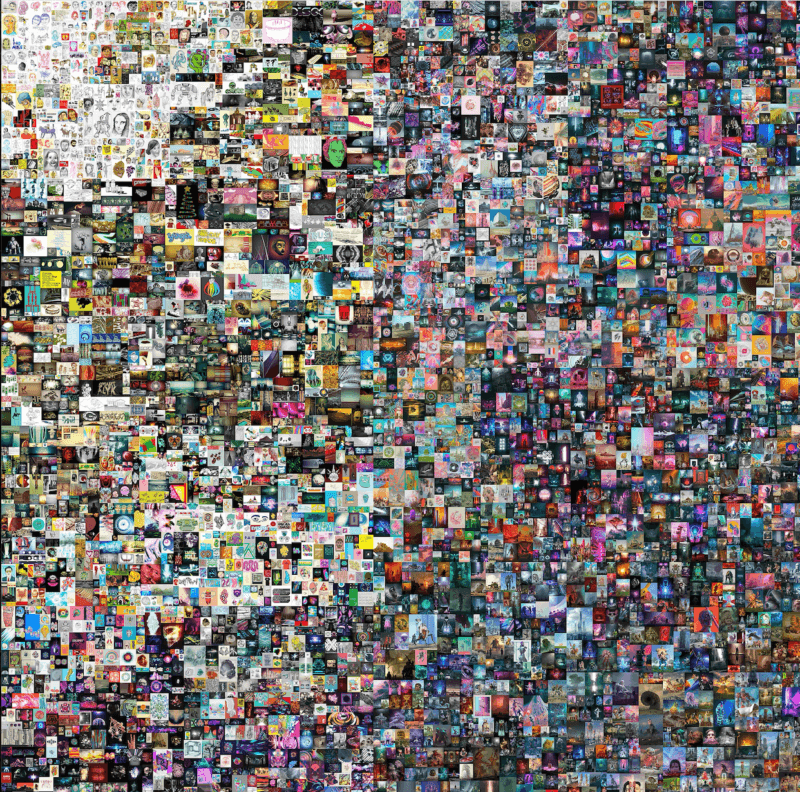
million at Christie’s in March 2021. It is a collage of 5,000 digital images created daily over 13 years, starting in May 2007. The work, often depicting surreal or political scenes, was purchased by NFT investor Vignesh Sundaresan
was the headline that pulled the entire art world’s attention toward Ethereum, smart contracts, and a phrase most people had never heard before: non-fungible token. I closed that post by saying I believed NFTs were here to stay.
Five years later, I want to come back to that claim with fresh eyes. Some of what I wrote held up. Some of it didn’t. And the picture in 2026 is very different from the one I was looking at when the hype was at its peak.
This is a neutral look back — not a victory lap and not a takedown. Just an honest accounting of where things are.
What I got right
A few of the bones of that original post still feel sound.
NFTs did establish a working model for digital scarcity and provenance. The blockchain still does what it was advertised to do: it keeps an immutable public record of who minted a work, who bought it, and what they paid. For collectors who care about provenance — and serious collectors always do — that record is genuinely useful. It hasn’t gone away.
I also said that some of the earliest, most committed players were going to stick around regardless of the speculative tide. That turned out to be true. There’s a quieter, more durable community of artists, curators, and collectors who were working with blockchain art before 2021 and who are still working with it now. Major institutions — MoMA, LACMA, the Pompidou, the Whitney — have all acquired blockchain-based works in recent years.1 The infrastructure for treating digital art as collectible art didn’t evaporate. It just got smaller and quieter.
And I said to give it time. That part aged well too — though probably not in the way I meant it.
What I got wrong (or oversold)
I was too optimistic about a few things.
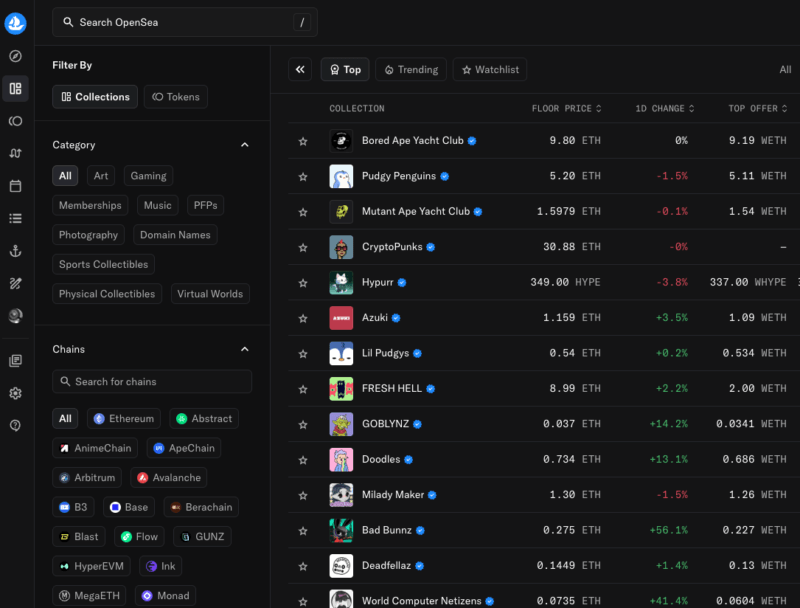
I leaned heavily on the idea that artists would finally collect “continual residual value” through royalties — that the blockchain would automatically pay creators a percentage every time their work resold. In 2021 that felt like a revolution for artists. By 2023, the royalty model had largely broken down. When the marketplace Blur began routing trades around creator royalties to compete on fees, OpenSea — the dominant marketplace at the time — followed by making royalties optional rather than enforced.2 The race to zero gutted the very mechanism that made NFTs feel transformative for working artists.
The picture has since stabilized somewhat. Newer token standards like ERC-721C give artists technical tools to enforce royalties at the contract level, and by 2025 over 80% of newly deployed NFT contracts had enforcement built in. Ethereum-based creators collectively earned around $920 million in royalties in 2025.3 But the industry-wide assumption that “the blockchain pays you forever” turned out to require constant defending. It wasn’t automatic. It was a fight, and a lot of artists got caught in the middle of it.
I also underestimated how much of the early NFT market was speculation rather than collecting. When the broader crypto market crashed in 2022, NFT trading volume — which had peaked at roughly $2.9 billion in 2021 — collapsed to about $197 million by 2024 and as low as $23.8 million in early 2025.4 The number of active traders fell from over 500,000 to under 20,000. Bored Apes, CryptoPunks, and most of the celebrity-driven PFP collections lost more than 90% of their peak value.5 A lot of people who got in late lost real money.

I should have been clearer that what looked like an art market was, for a stretch in 2021 and 2022, mostly a casino with art-shaped chips.
Where things actually landed
Here’s the 2026 picture as best I can describe it.
The speculative frenzy is over. What’s left is a smaller market with a clearer shape. Curated platforms — SuperRare, Foundation, MakersPlace, Verse, fxhash — are still operating, still vetting artists, and still hosting genuine digital art collecting.6 SuperRare, for instance, has done collaborations with Gucci, partnered with Miami Art Week, and even opened a physical gallery to display work that originated on chain.7 That kind of crossover would have sounded absurd in 2021; today it’s just the business.
The technical landscape has shifted too. Ethereum’s move to proof-of-stake in 2022 dramatically lowered the energy footprint that made a lot of artists uncomfortable in the early days. Tezos became the home for a particular kind of generative and creative-coding community via fxhash. Bitcoin, of all chains, picked up new NFT activity through the Ordinals protocol. The “Ethereum or nothing” framing of my original post is no longer accurate.
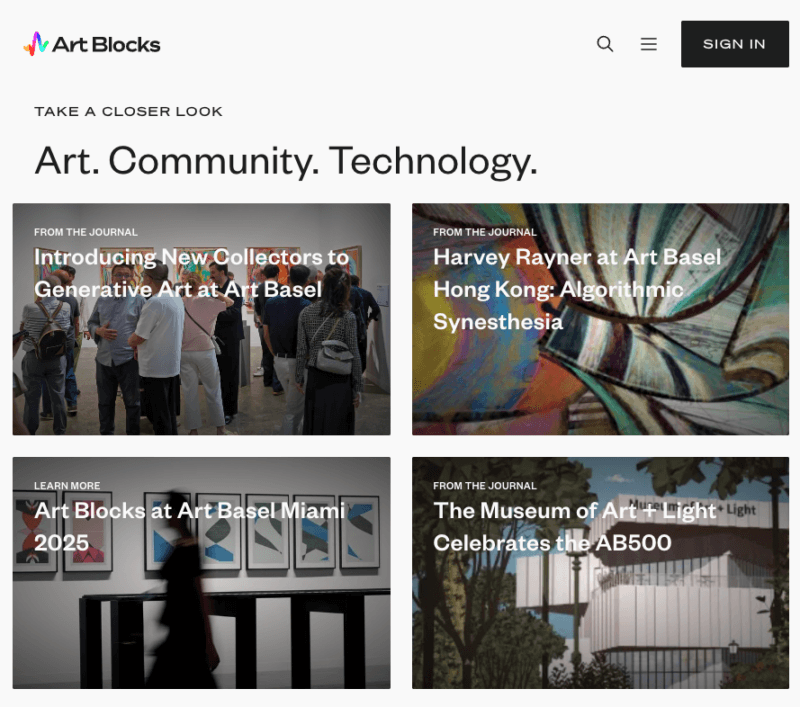
Generative art platforms like Art Blocks and fxhash have arguably produced the most durable art-historical contribution of the whole NFT era. These are pieces where the code itself is the artwork, minted on chain so that each instance is provably unique. That work is being collected, written about, and shown in museum contexts — not because it’s an NFT, but because it’s interesting art that happens to use the blockchain as its native medium.8
And the headline artists are still working. Beeple opened a physical studio space in Charleston, has continued to make new work, and showed an installation called Regular Animals at Art Basel Miami Beach in 2025.9 Pak’s The Merge — which sold for $91.8 million in 2021 — remains the highest-priced NFT on record.10 But the news cycle around any of this is much smaller than it was. The art is doing what art does. The hype just left.
What’s different in 2026 if you’re new to this
If you’re a collector or an artist looking at this space for the first time today, a few things are worth knowing.
The cost of entry is much lower than it was. Gas fees on Ethereum are a fraction of what they were in 2021. Tezos and a number of layer-2 networks make minting genuinely cheap. The friction that kept casual artists out is mostly gone.
The risk profile has changed. You’re no longer walking into a market where pieces routinely double in a month. You’re walking into something more like a normal art market — slow, relationship-driven, with most works selling for modest sums and a small number of names commanding real prices.
The legal picture is clearer but not settled. The SEC and other regulators have brought enforcement actions against several NFT projects, and royalty enforcement, copyright, and securities classification are all still being worked out in court and in legislation. Anyone selling work at scale should pay attention to that.
And the “NFT” label itself has largely fallen out of favor. People doing serious work in the space now tend to talk about “digital art,” “on-chain art,” or “blockchain provenance” rather than NFTs, which has become associated with the speculative era. That shift in vocabulary matters because it tells you what the serious end of the market thinks the technology is actually for.
What I’d say now to an artist asking whether to mint
In 2021 I said: get in early, learn the vocabulary, wait for the opportunity. I’d say something different now.
The blockchain is a tool. It is good at exactly one thing — keeping an unalterable public record — and it is not good at most of the other things people promised it would do. It will not get you discovered. It will not make your work valuable on its own. It will not protect you from theft in any country whose copyright laws don’t already protect you. And it will not, by itself, pay you royalties on the resale market unless you and your platform actively defend that mechanism.
What it will do is give your work a verifiable provenance that travels with it forever. That is genuinely useful. The question for every artist is whether that single, narrow benefit is worth the time, the platform fees, and the cognitive load of operating in a space that is still finding its footing.
For my own follow-up post, I want to lay out what I think the most sensible approach looks like for traditional artists in 2026 — one that uses the blockchain for what it’s actually good at, without asking the rest of your practice to revolve around it.
That’s coming next.
Footnotes
- Charlotte Kent, “After the boom and bust, an era of ‘greater maturity’ for art and the blockchain?” The Art Newspaper, December 8, 2023. https://www.theartnewspaper.com/2023/12/08/after-the-boom-and-bust-an-era-of-greater-maturity-for-art-and-the-blockchain
- André Beganski, “OpenSea Drops Fees, Cuts Creator Royalty Protections as Rival Blur Rises,” Decrypt, February 17, 2023. https://decrypt.co/121638/opensea-drops-fees-royalty-protections-blur-rises
- “NFT Royalties Statistics 2026: How Creators Profit Big,” CoinLaw. https://coinlaw.io/nft-royalties-statistics/
- “NFT art in crisis: from $2.9 billion to $23 million, is it really the end?” The Cryptonomist, March 28, 2025. https://en.cryptonomist.ch/2025/03/28/nft-art-in-crisis-from-2-9-billion-to-23-million-is-it-really-the-end/
- “Will the NFT art market ever recover?” South China Morning Post Style. https://www.scmp.com/magazines/style/lifestyle/leisure/article/3260161/will-nft-art-market-ever-recover-bored-apes-and-cryptopunks-cashed-and-crashed-out-when-crypto
- “Navigating NFTs and the Cryptoart Market in 2025,” ArtConnect Magazine. https://www.magazine.artconnect.com/resources/navigating-nfts-and-the-cryptoart-market
- “SuperRare Review 2026: NFT Marketplace & Fees,” Milk Road. https://milkroad.com/reviews/superrare/
- “The Generative Art Market Today,” Outland. https://outland.art/generative-art-nfts-fxhash-highlight/
- “Beeple’s 2025 Art Basel Stunt,” Medium / CreedTec, 2025. https://medium.com/@creed_1732/beeples-2025-art-basel-stunt-exposes-the-truth-about-generative-ai-systems-900d2da7b0b3
- “The 20 Most Expensive and Famous NFT Sales of All Time,” NFT Now. https://nftnow.com/features/most-expensive-nft-sales/
