
Art Traveler
The Case for Doodling

May
Growing up, I did something teachers frowned upon. It was written off as daydreaming, boredom, or just killing time. I was doodling. What no one thought to mention was that this simple habit would shape the rest of my life. It quietly guided my career as an artist and designer, and it still influences how I think and work today.
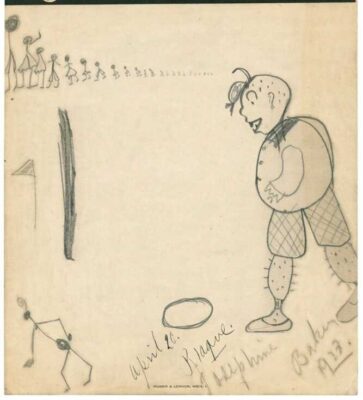
Is doodling a form of income for me? Not directly. But it’s how I begin almost everything I make. For those of us in the creative field, it’s not optional — it’s the engine. And the benefits of doodling reach far beyond creativity. Some of the most extraordinary art, design, architecture, film, and photography the world has ever seen started as a rough mark on a scrap of paper. I’d go so far as to say doodling has meaningfully shaped human progress across many disciplines.
I work with a digital tablet regularly, but nothing replaces the feel of a pencil on paper. For the purposes of this article, that’s exactly what we’re talking about.
What is doodling — and why does it matter?
Doodling is the practice of making marks without overthinking them. It usually happens when the mind starts to wander — and that’s exactly the point. Some doodles are more refined than others, and not everyone draws with the same ease. But doodling was never meant to be mastered. It belongs to everyone, at every skill level.
We doodle for all kinds of reasons. Sometimes it’s completely unconscious. Other times it’s deliberate — a way of working through something mentally before we can put it into words. It’s considered an expression of the inner self, a glimpse into the subconscious. For artists and designers, doodling isn’t just enjoyable — it’s necessary. It’s how the mind releases ideas and the hand catches them before they disappear.
The benefits of doodling are more real than you might think
Like exercise, diet, or meditation, doodling can be far more than a way to pass the time. Researchers have found measurable, documented benefits to the practice — and they apply whether you can draw or not.
Doodling for stress relief. Stress management is one area where doodling quietly punches above its weight. The Centers for Disease Control and Prevention links chronic stress to a wide range of physical and emotional symptoms — headaches, body pain, irritability, disrupted sleep, and more. Meanwhile, scientists, educators, and artists agree that doodling can soothe those feelings. A 2016 study of 39 university students, staff, and faculty found that after making art, 75 percent of participants showed lower cortisol levels — regardless of whether the work was detailed or just scribbling. Artistic ability made no difference. Researcher Karen Sosnoski, Ph.D., concluded that art-making “could be a way to regulate mood and addictive behaviors.” That’s a significant finding for something most of us do without even thinking about it.
Doodling and memory retention. Here’s something that will make you feel better about every idle sketch you’ve made during a long meeting. A study by Jackie Andrade at the University of Plymouth’s School of Psychology found that participants who doodled while listening to a recorded phone message recalled significantly more information than those who didn’t. Andrade concluded that doodling “helps to stabilize arousal at an optimal level” — keeping the mind engaged rather than drifting. Touch is a powerful sense. When sight and touch are working together, the brain tends to stay more present — and hold onto more. I can personally vouch for this. The act of drawing keeps you tethered to the moment in a way that passive listening simply doesn’t.
Doodling, focus, and the creative process. For those of us who think visually, doodling — what we sometimes call thumbnail sketches or pencil roughs — is how we solve problems. It draws on the hippocampus, pulling from stored visual memory: design principles, symbols, references absorbed from film, architecture, travel, books, and galleries. It generates volume. Ideas multiply on paper in a way they never quite do on a blank screen.
Late graphic designer Milton Glaser captured it well in his book Drawing is Thinking: drawing “is not simply a way to represent reality, but a way to understand and experience the world.” That distinction matters. How you see the world is uniquely yours — and doodling is one of the most direct ways to get that vision out of your head and into a form others can actually experience.
For creatives working under deadline pressure, it can be tempting to skip the sketch and go straight to digital. Sometimes that works. But a digital shortcut rarely generates the same emotional investment in an idea. After thousands of projects over the course of my career, sketching and doodling are still my first move — not out of habit, but because nothing else works the same way.
Doodling isn’t just for creatives
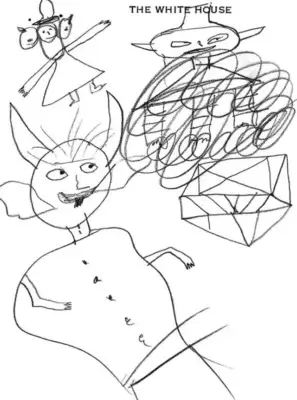
The benefits of doodling aren’t reserved for artists and designers. U.S. presidents have been known to do it. If you want to manage stress, sharpen your memory, stay present in long meetings, or simply find a calmer way to move through the day, doodling is worth adding to your regular routine. There’s also growing research on its benefits for aging populations — enough material for an article of its own.
The habit that got me in trouble in grade school turns out to be one of the best ones I ever kept. If you’ve been looking for a reason to pick up a pencil and let your mind go — this is it.
The “thinking” benefits of doodling, by Srini Pillay, MD, Contributor, Harvard Health.
The Mental Health Benefits of Doodling, by Karen Sosnoski, Ph.D. on November 13, 2020
Sunni Brown, author of “The Doodle Revolution: Unlock the Power to Think Differently.
Drawing is Thinking”, by Graphic Designer, Milton Glaser.
What Does Doodling Do?, Jackie Andrade, School of Psychology, University of Plymouth, UK
