
Art Traveler
Uncovering the Magic: How I Authenticated My Early 1900s Carter the Great Lithograph
Dec
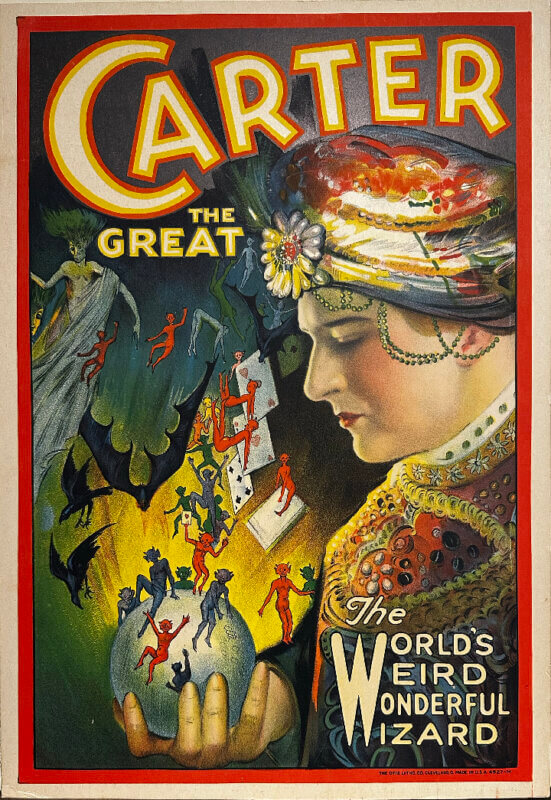
There is a special kind of thrill that comes from uncovering a piece of printmaking history. Collectors know it immediately — the quickened pulse, the careful hands, the quiet internal negotiation between excitement and skepticism. That’s exactly where I found myself when I discovered what appeared to be an original Carter the Great poster at Cotton’s Antique Emporium in Pueblo, Colorado.
The store itself was massive, settled in downtown Pueblo during the city’s annual Chile and Frijoles Festival — a lively, crowded celebration that fills the streets every September. I wasn’t looking for anything specific that day. But as a creator, designer, and collector of vintage posters, I’ve trained myself to slow down in spaces like that. And slowing down paid off.
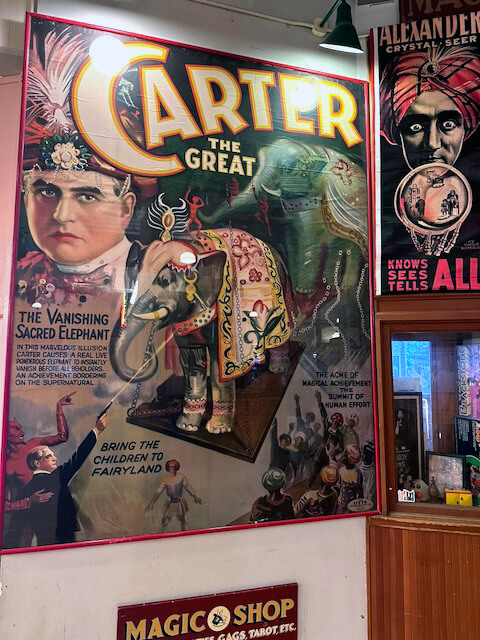
I had seen a version of this same poster years before — a wall-sized reproduction near Seattle’s Pike Place Market, its colors vivid enough to stop you mid-step. I never imagined I’d come across what might be an actual early 20th-century lithograph of the same image. But there it was.
Who Was Carter the Great?
Before getting into the authentication process, it helps to understand the man behind the poster — because the history of the artwork and the history of the artist are inseparable.
Charles Joseph Carter (June 14, 1874 – February 13, 1936) was one of the most celebrated stage magicians of the early 20th century. Born in New Castle, Pennsylvania, he made his first public appearance at age 10 as “Master Charles Carter, the Original Boy Magician.” He went on to complete seven world tours before 1917, traveling with an act that at one point weighed 31 tons of equipment — elephants that vanished on command, a surgical-themed sawing illusion with nurses in attendance, and a signature finale in which a shrouded Carter appeared to hang at the gallows before disappearing entirely.
His posters were as theatrical as his performances. Designed to be wheat-pasted to the sides of buildings well in advance of his arrival, they announced something extraordinary was coming to town. And the company that produced them — the Otis Lithograph Company of Cleveland, Ohio — was one of the finest printing operations of the era.
The Otis Lithograph Company: Cleveland’s Printing Powerhouse
According to Artvee and the WorldCat archive, the Otis Lithograph Company was active from the 1880s through the 1930s and specialized in theatrical and vaudeville posters, magic and illusionist imagery, window cards, circus-style illustration, and early film and commercial advertising. Their collection includes over 400 large-format lithographic theatrical posters designed to advertise specific shows and performers.
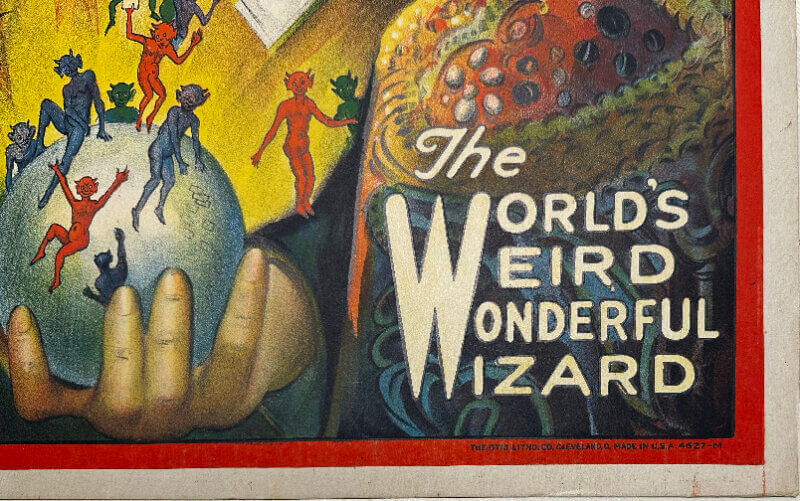
For collectors, the Otis credit line — typically printed along the lower margin — is one of the strongest markers of period authenticity. As Poster House documents, Carter’s posters from the 1920s were produced by Otis via stone lithography and would have been printed as multi-sheet formats for large-scale outdoor display. The craftsmanship is unmistakable: deep jewel tones, Art Deco-influenced composition, and the kind of registration precision that only skilled press operators could achieve by hand.
As the Smithsonian Magazine and the Harry Ransom Center at the University of Texas have both noted, the golden age of magic posters — roughly 1880 to 1930 — represented a perfect convergence of advances in color lithography and the rise of the touring stage illusion show. It took a full team to produce each poster: art directors conceiving the concept, lettering specialists tracing type onto limestone slabs, and colorists filling in vivid, layered hues. The results were some of the most visually striking commercial art ever produced in America.
The Find at Cotton’s
One of the shop owners at Cotton’s shared that the poster had come from an estate sale in the 1990s. That detail mattered. High-quality fine art reproductions existed then, but widespread commercial giclee printing didn’t take hold until the early 2000s. A piece acquired at estate sale in that era was worth examining seriously.
I inspected it closely using a loupe and the zoom on my iPhone 14. It passed the size test typical of early theater window posters. And one of the most telling details — the back of the paper — showed aged, uncoated stock with ink marks and printing imperfections consistent with original lithographic production. A modern fine art reproduction would show a bright, clean white reverse. This did not. I bought it.
The Art of Stone Lithography
Once the poster was home, I went deeper into understanding how it was made. Stone lithography, which dominated commercial poster printing before offset presses took over, is a remarkably labor-intensive process. According to Collectors Weekly, the process worked as follows:
An artist drew directly onto a smooth limestone slab using greasy crayons or ink. The stone was then treated chemically so that non-image areas absorbed water while repelling oil-based ink. The ink adhered only to the drawn image areas. Paper sheets were pressed onto the stone one at a time, and each color in the final image required its own stone, its own ink run, and its own careful hand-alignment.
The result was something no digital process can fully replicate: lush, layered color with a slightly textural, painterly surface; subtle variation from print to print; and a rich visual depth built up through multiple transparent ink passes. These qualities — and their absence — remain central to authenticating early lithographs today.
How I Evaluated My Poster
With a clearer understanding of the process, I examined my own Carter the Great poster with greater intention across six areas:
1. Provenance. The chain of ownership — estate sale in the 1990s, then Cotton’s Antique Emporium, then my collection — is documentable. As I’ve written elsewhere on this blog, provenance alone doesn’t authenticate a piece, but it meaningfully supports the case when combined with physical evidence.
2. Printer’s Credit. Authentic Otis posters often carry a small imprint along the lower margin: “Otis Litho Co., Cleveland.” This is one of the strongest attribution markers available to collectors, and its presence — or absence — should be among the first things you check.
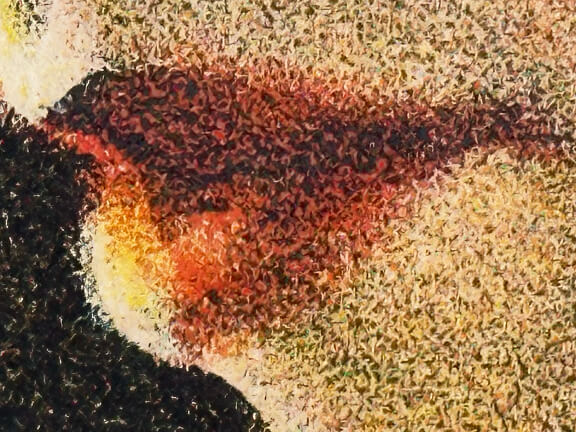
3. Ink Texture Under Magnification. According to Authentic Vintage Posters, stone lithographs show a random, organic pattern in the color layout — the natural texture of ink applied to limestone rather than the mechanical dot grid of offset printing. Using magnification, I checked for continuous tone without halftone dots, crayon or tusche textures consistent with hand-drawn litho work, and layered ink buildup visible under raking light. The poster showed all three.
4. Paper and Wear Patterns. As Poster Group’s collector guide notes, original vintage posters were printed on thin lithographic paper that ages softly — showing slight discoloration, edge wear, and minor brown spotting. Bright white, smooth paper is nearly always a sign of modern reproduction. My poster showed age toning, slight brittleness at the edges, and ink transfer marks on the reverse. Because it appeared to have been stored unused rather than displayed, it lacked tack holes — which is consistent with old stock rather than a red flag.
5. Comparison With Auction and Museum Archives. Cross-referencing my poster against documented examples from auction houses like Potter & Potter and Haversat & Ewing — both of which specialize in vintage magic memorabilia — and against museum holdings confirmed matching colors, compositional layout, and dimensions consistent with known period examples.
6. Expert Review. For the highest level of verification, a paper conservator can analyze fiber composition, ink chemistry, and age markers with scientific precision. I have not yet pursued this step, but it remains the gold standard for any significant acquisition.
A Guide for Collectors: How to Authenticate Your Own Magic Poster
Whether you are evaluating a Carter, Thurston, Blackstone, or Houdini-era poster, here is a streamlined approach:
Step 1 — Look for a Printer’s Imprint. Common authentic printers of the era include Otis Litho Co. (Cleveland), Strobridge Litho Co. (Cincinnati), Erie Litho & Printing Co., and Russell-Morgan. Check the lower margin and bottom corners.
Step 2 — Inspect with a Loupe. Use a 10× magnifier. Look for the absence of halftone dots, visible crayon strokes or organic ink lines, and slight color misalignment between layers. Perfectly spaced mechanical dots indicate modern offset printing.
Step 3 — Examine the Paper. Authentic early-1900s poster stock shows natural age toning, visible fiber texture, slight brittleness, and pressure impressions from the press. Bright white, smooth paper is a strong indicator of reproduction.
Step 4 — Look for Use-Related Wear. Tack holes, tape remnants, display fading, and edge abrasions are common on posters that were actually used. Their absence on otherwise authentic pieces — as with unused old stock — is not disqualifying, but their presence strengthens the case.
Step 5 — Compare with Documented Examples. Research Carter the Great, Thurston, and Otis Lithograph archives. Cross-reference against auction results and museum holdings. Matching colors, layout, and dimensions across multiple verified examples is meaningful evidence.
Step 6 — Consult a Paper Conservator. For significant purchases, scientific analysis of paper fibers, ink chemistry, and aging markers provides the most definitive authentication available.
Why It Matters
A true stone lithograph is more than a poster. It is a handcrafted artifact from a golden age of stage magic — a record of forgotten craft techniques, early American commercial printmaking, touring performance culture, and the extraordinary visual language that a generation of artists developed to make entire cities stop and look.
My Carter the Great poster carries its own story through every ink layer, every printing blemish, every fiber of its aged stock. Understanding how it was made has only deepened my appreciation for what it represents. These pieces are increasingly rare, increasingly studied, and for collectors willing to do the work, entirely within reach.
For more on Charles Joseph Carter, visit the Charles Carter tribute site and Magicpedia.
Sources
- Charles Joseph Carter — Wikipedia
- Carter the Great — Poster House
- Otis Lithograph Co. — WorldCat
- The Otis Lithograph Co. — Artvee
- The Golden Age of Magic Posters — Smithsonian Magazine
- The Golden Age of Magic Posters — Harry Ransom Center, University of Texas
- Dark Art: Spectacular Illusions from the Golden Age of Magic — Collectors Weekly
- Stone Lithograph Authentication — Authentic Vintage Posters
- How to Identify Authentic Vintage Posters — Poster Group
- Carter the Great — Magicpedia
- A Tribute to Charles Carter — charlescarter.co.uk
